
Welcome Week, 24-28 November 2025, at USAMV Cluj-Napoca, as part of the EU-Gift project
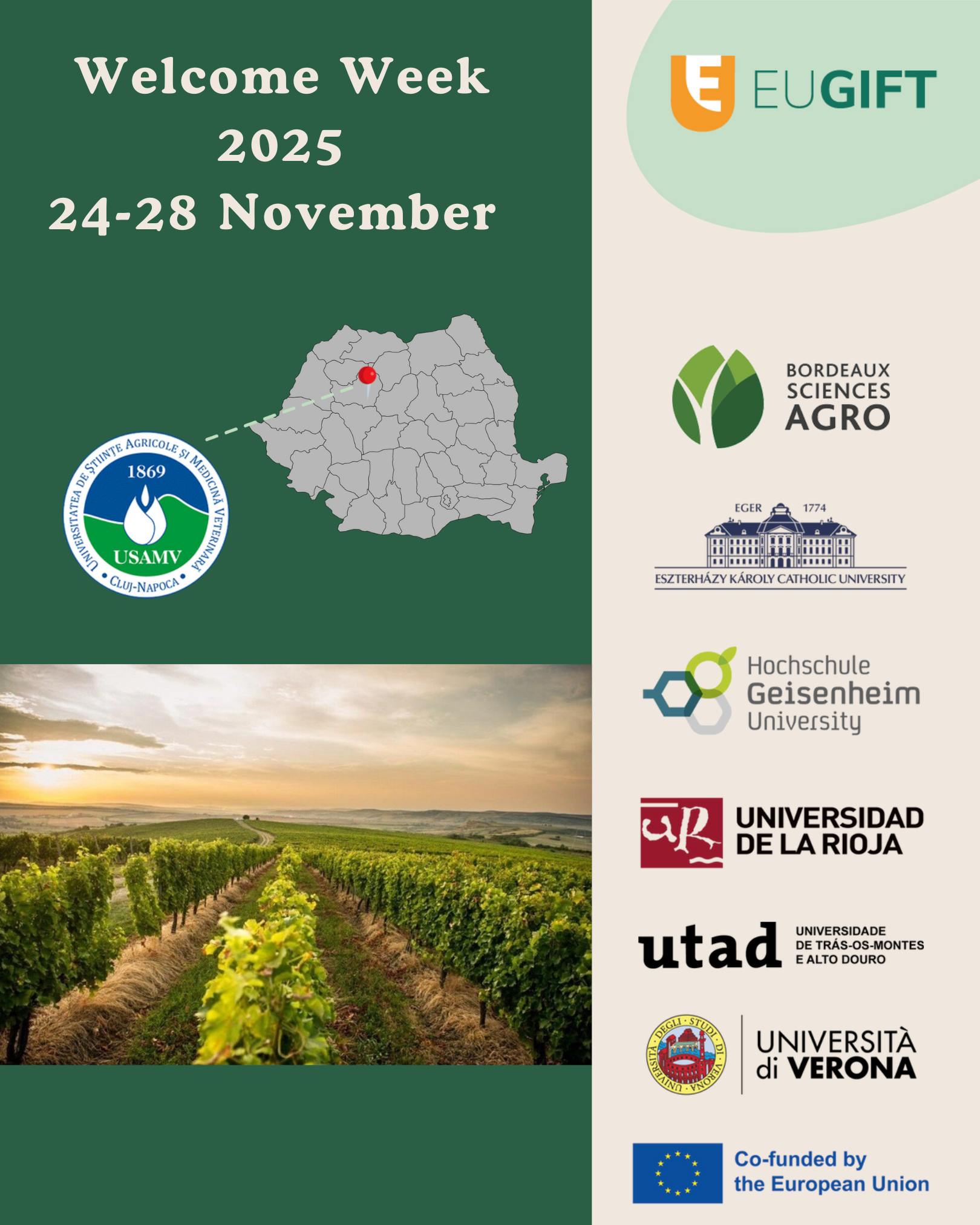
The University of Agricultural Sciences and Veterinary Medicine (USAMV) Cluj-Napoca is hosting Welcome Week, between 24 and 28 November 2025, as part of the EU-Gift project. Throughout the week, students and guests will participate in presentations, seminars, workshops and themed visits dedicated to food safety, product authenticity, traditional gastronomy and sustainability,
The programme includes:
Presentation of the EU-GIFT project;
Interactive Policy Lab on global food security;
Seminars dedicated to food authenticity;
Workshop “How to build food security”;
Visits to companies in the food sector;
Tastings of local products.
“We are honoured to be part of the EU-GIFT Alliance – European University for Geographical Identity & Sustainable Food Systems (https://eu-gift.com), alongside prestigious European universities in Spain, Italy, France, Germany, Portugal and Hungary: University of La Rioja, University of Verona, National School of Agricultural Engineering – Bordeaux Sciences Agro, University of Geisenheim, University of Trás-os-Montes e Alto Douro (UTAD) and University of Eszterházy Károly. Together, we are building a common vision: the development of sustainable food systems, anchored in geographical identity, innovation and excellence in education,” is the message from Prof. Dr. Elena Mudura, project director from USAMV Cluj-Napoca.
The working teams from each partner university also met on 13-15 October 2025 at the Eszterházy Károly Catholic University in Eger (Hungary), where they consolidated their joint activities and planned the next steps in the alliance’s collaboration.
EU-GIFT actively contributes to the development of a European strategy for training and research in areas that are essential for the future of agri-food: sustainable agriculture, viticulture and oenology, food products differentiated by quality and origin, environmental protection and rural development. The partner countries account for a significant proportion of the European Union’s geographical indication products, which are an expression of our common cultural and economic heritage.